Since I do so love Jeff Foxworthy, and his "You might be a redneck if..." commentary, I decided to start a list of my own. Without further ado, "You might be a reptile person if..."
...You go digging through the recyclables to save plastic water bottle lids, toilet paper tubes, and egg crates.
...You go to bed sweating because it's become more efficient to heat the entire house than individual tanks.
...To you, Tupperware means 'sauna', not 'leftovers'.
...You wonder why anyone would buy the glass starter tanks, because clearly they aren't stack-able.
...You get irritated at a ten minute drive to the grocery store for food, but a four hour trip to the next expo seems perfectly reasonable.
...You can understand why someone would breed roaches.
...You've ever had to move the rats to get to your ice cream.
...When someone says, "Nice rack!", you look for a caging system.
...Similarly, "That guy has awesome balls," does not sound like an obscene reference to you.
...When the news reports a python on the loose, anything under 8' makes you shrug dismissively.
...You know why people hate shipping from California.
...You've ever looked at your collection and thought, "Hm, guess I'm not moving to Hawaii."
...The animals in your home have three different categories: Pets, Breeders, and Feeders.
...You actually have a species wishlist.
...You know the difference between UVA and UVB, and what the purpose of vitamin D3 is.
...And you actually care.
...The term, "Sperm Retention" means something to you.
...You see your friends will all of their cute, cuddly, furry, affectionate animals and don't really see the attraction.
...You catch yourself correcting people on the difference between a turtle and a tortoise.
...You've ever rolled your eyes about amphibians being lumped into the same category as tortoises, snakes, and lizards.
....You can explain to the person sitting next to you why they wouldn't be.
...You know that male snakes don't have a penis.
...You thought to yourself after that last one, "Great, now we're going to have yet another thing to clear up with all of the non-reptile people...."
Thursday, December 8, 2011

Saturday, September 3, 2011
Snake Pee and Smelling Salts
This journal entry was originally written on July 29th of 2010, while my reptiles and I were still residing in a single bedroom of my parents home. While the count of the animals fluctuates, and I now keep them outside of my bedroom, the sentiment remains the same. Enjoy!
--
Living in close quarters with animals will teach you nothing if not patience. As it currently stands (after a few unexpected losses, and downsizing for the move), I share my bedroom with three Ball Pythons, sixteen Crested Geckos, and one Leopard Gecko. One can only imagine what the room has looked like over the past sixteen years, constantly transforming to accommodate yet another tank when, just after adding the last one, I swore to myself that there was 'absolutely, positively, no more room.'
A light sleeper in general, I have (over time) become much more adept at continuing to snooze straight through the various bumps, thumps, rustles, clicks, chirps, thunks, and other assorted noises in the night. The one thing I have not adjusted to is... snake pee. (Henceforth referred to by its scientific name, 'urates'.)
Currently, my bed is lofted six feet into the air to allow myself some actual living storage space; all said and done, I use the area under my bed for supplies and clothing, and sleep roughly 18" from the ceiling. Sleeping quarters are cramped, with poor air circulation and heat issues - or, as I call it, "cozy".
It is not quite so 'cozy' at two o'clock in the morning, when I have suddenly come from REM sleep to full consciousness at lightning speed, only to discover that my sinuses and lungs are ON FIRE and I can barely breathe.
Between the nocturnal nature of the animals I keep, the natural out-gassing of waste products, and the very poor circulation of air around my head at night, I regularly find myself waking up in just such a manner. There's no polite way to say it - urates STINKS. It is, basically, a waste form of ammonia; ammonia, as you may or may not know, is the main ingredient in smelling salts. It has become no real surprise to the rest of my family to discover me up and scrubbing tanks in my boxer shorts at three a.m., or crashed on the futon in the living room for the night with my bedroom window open until the area becomes 'livable' again. (It also helps explain why all of the animals are in my room - it's tough to make an argument for having any part of the rest of the house smell like that. Maybe we could keep them in the bathroom?)
It also makes it obvious that the only people who keep animals like that are people that love them.
I have heard many people exclaim, "Oh, isn't it darling!" about a newborn baby - and maybe, to some, it is; wrinkly, purple, crying and screaming and smelling of sour-milk-y vomit... Adorable. For the most part, though, I think there's something about that statement that rings most true for the mother and father; the ones that have been up all night feeding it, changing its diapers, burping it, and singing it back to sleep as best as they can - the ones that changed their lives to have it in their homes.
That's how it is for me with my reptiles; where many people look at them and see a scaly representation of evil itself (which is sometimes how I view newborns, so I'll call it an even trade), I see my own version of a kid - the thing I've worked my life around to keep.
--
Living in close quarters with animals will teach you nothing if not patience. As it currently stands (after a few unexpected losses, and downsizing for the move), I share my bedroom with three Ball Pythons, sixteen Crested Geckos, and one Leopard Gecko. One can only imagine what the room has looked like over the past sixteen years, constantly transforming to accommodate yet another tank when, just after adding the last one, I swore to myself that there was 'absolutely, positively, no more room.'
A light sleeper in general, I have (over time) become much more adept at continuing to snooze straight through the various bumps, thumps, rustles, clicks, chirps, thunks, and other assorted noises in the night. The one thing I have not adjusted to is... snake pee. (Henceforth referred to by its scientific name, 'urates'.)
Currently, my bed is lofted six feet into the air to allow myself some actual living storage space; all said and done, I use the area under my bed for supplies and clothing, and sleep roughly 18" from the ceiling. Sleeping quarters are cramped, with poor air circulation and heat issues - or, as I call it, "cozy".
It is not quite so 'cozy' at two o'clock in the morning, when I have suddenly come from REM sleep to full consciousness at lightning speed, only to discover that my sinuses and lungs are ON FIRE and I can barely breathe.
Between the nocturnal nature of the animals I keep, the natural out-gassing of waste products, and the very poor circulation of air around my head at night, I regularly find myself waking up in just such a manner. There's no polite way to say it - urates STINKS. It is, basically, a waste form of ammonia; ammonia, as you may or may not know, is the main ingredient in smelling salts. It has become no real surprise to the rest of my family to discover me up and scrubbing tanks in my boxer shorts at three a.m., or crashed on the futon in the living room for the night with my bedroom window open until the area becomes 'livable' again. (It also helps explain why all of the animals are in my room - it's tough to make an argument for having any part of the rest of the house smell like that. Maybe we could keep them in the bathroom?)
It also makes it obvious that the only people who keep animals like that are people that love them.
I have heard many people exclaim, "Oh, isn't it darling!" about a newborn baby - and maybe, to some, it is; wrinkly, purple, crying and screaming and smelling of sour-milk-y vomit... Adorable. For the most part, though, I think there's something about that statement that rings most true for the mother and father; the ones that have been up all night feeding it, changing its diapers, burping it, and singing it back to sleep as best as they can - the ones that changed their lives to have it in their homes.
That's how it is for me with my reptiles; where many people look at them and see a scaly representation of evil itself (which is sometimes how I view newborns, so I'll call it an even trade), I see my own version of a kid - the thing I've worked my life around to keep.
Sunday, May 15, 2011
I sometimes indulge in shameless self promotion.
I've said it before, I'll say it again - the reptile industry isn't the one to get into if you're in it for the cash and prizes.
That said, it's a frickin' awesome hobby, especially during Spring!
If you don't know about my webpage yet, go ahead and check it out:
www.partygecko.com
You can also follow us on Facebook by going here:
http://www.facebook.com/partygecko#!/
That said, it's a frickin' awesome hobby, especially during Spring!
If you don't know about my webpage yet, go ahead and check it out:
www.partygecko.com
You can also follow us on Facebook by going here:
http://www.facebook.com/partygecko#!/
Monday, May 9, 2011


Saturday, April 23, 2011
DIY - Isolation/Hydration Station
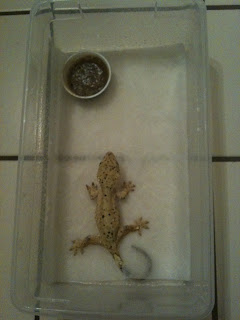
Every once in a while, you're going to need to separate one of your animals from the others - whether it's a new arrival, an illness, an injury, aggression, etc. This can be done quickly and easily, for far less than the cost of setting up an entirely new tank. The DIY I'm showing here is designed for temporary use (generally for injury or hydration), since it's such a basic set-up, but it can be easily modified to suit your needs.
In this case, I'm showing you how to make a 'hydration station' for a Crested Gecko.
Since I'm working with smaller animals, I'm using a plastic shoe box that was given to me by a friend of mine - I've also used plastic tubs designed for storage, which can be used to accommodate larger animals.
As substrate, I've laid down a couple paper towels. Paper towels are an excellent substrate for hydration, as they hold quite a bit of moisture - they are also a great choice for juveniles of many species, as well as injured animals due to their cleanliness, ease of changing, and color (white, simple backgrounds are far easier to spot waste and other important to see items on).
I've misted heavily, and placed a food dish into the shoebox.
Using a paring knife, I poked several holes in the lid.
(Apologies for the angle, but it does show some of the holes better than a straight on view.)

Annnnnd... that's it.
Easy, huh? :)
Now, for a recovering animal, this is a pretty solid set up (add a water dish if they're going to be in there for more than a few hours, even with a heavy mist) - for an animal that just needs to be separated and is going to be in there for a prolonged period of time, use a larger space and add more decorations (paper towel and toilet paper tubes work well for a variety of species). Done and done. Quick, easy, and inexpensive.
In this case, I'm showing you how to make a 'hydration station' for a Crested Gecko.
Since I'm working with smaller animals, I'm using a plastic shoe box that was given to me by a friend of mine - I've also used plastic tubs designed for storage, which can be used to accommodate larger animals.
As substrate, I've laid down a couple paper towels. Paper towels are an excellent substrate for hydration, as they hold quite a bit of moisture - they are also a great choice for juveniles of many species, as well as injured animals due to their cleanliness, ease of changing, and color (white, simple backgrounds are far easier to spot waste and other important to see items on).
I've misted heavily, and placed a food dish into the shoebox.

Using a paring knife, I poked several holes in the lid.
(Apologies for the angle, but it does show some of the holes better than a straight on view.)

Annnnnd... that's it.
Easy, huh? :)
Now, for a recovering animal, this is a pretty solid set up (add a water dish if they're going to be in there for more than a few hours, even with a heavy mist) - for an animal that just needs to be separated and is going to be in there for a prolonged period of time, use a larger space and add more decorations (paper towel and toilet paper tubes work well for a variety of species). Done and done. Quick, easy, and inexpensive.
Sunday, April 17, 2011
A Horse Of Many Colors (aka: Before and After Photos)
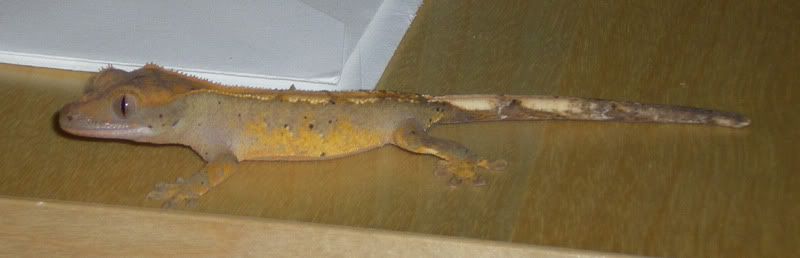
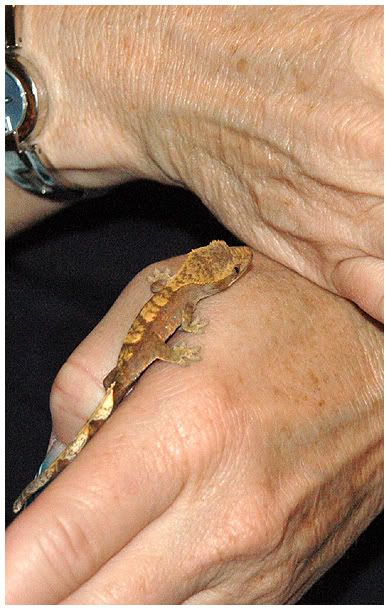
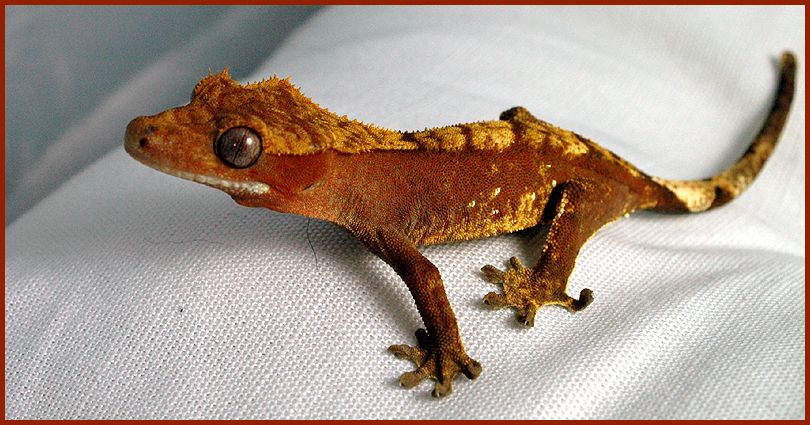
One of the super interesting things about Crested Geckos - to me, anyway - is the amount of change in coloration that they can go through as they mature. I noticed this most dramatically with Norbert as I was looking through old files the other day, and as such, felt like posting a few progression shots.
This is Norbert shortly after I got him, weighing in at 4-5 grams.

This is Norbert as of last week, about three years after the original photo:

This is a gecko of mine, Zippo, when she weighed approximately 2-3 grams:

And this is the same gecko when she was approximately a year old (I'd post a photo of her today, but she never fires up so you can see her true colors anymore):

This is Norbert shortly after I got him, weighing in at 4-5 grams.
This is Norbert as of last week, about three years after the original photo:

This is a gecko of mine, Zippo, when she weighed approximately 2-3 grams:
And this is the same gecko when she was approximately a year old (I'd post a photo of her today, but she never fires up so you can see her true colors anymore):
Thursday, April 7, 2011
I Get Lizards In The Mail
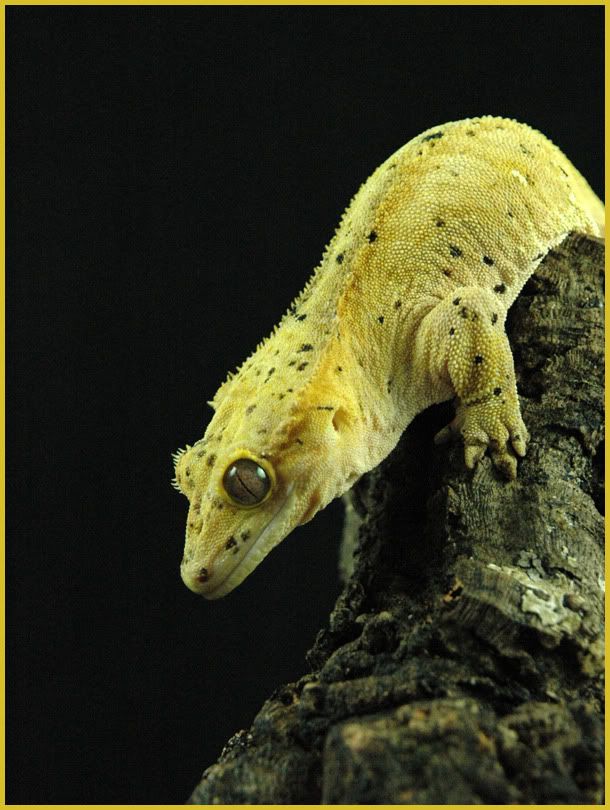
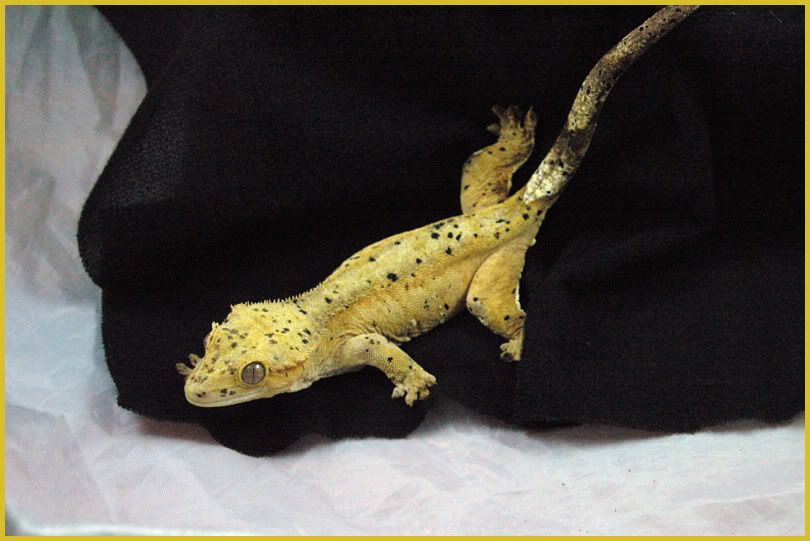
Norbert's new girlfriend has arrived.
The husband stayed in on Tuesday morning in order to sign off on the package. <3
Without further ado, meet Finch.


The husband stayed in on Tuesday morning in order to sign off on the package. <3
Without further ado, meet Finch.
Subscribe to:
Posts (Atom)